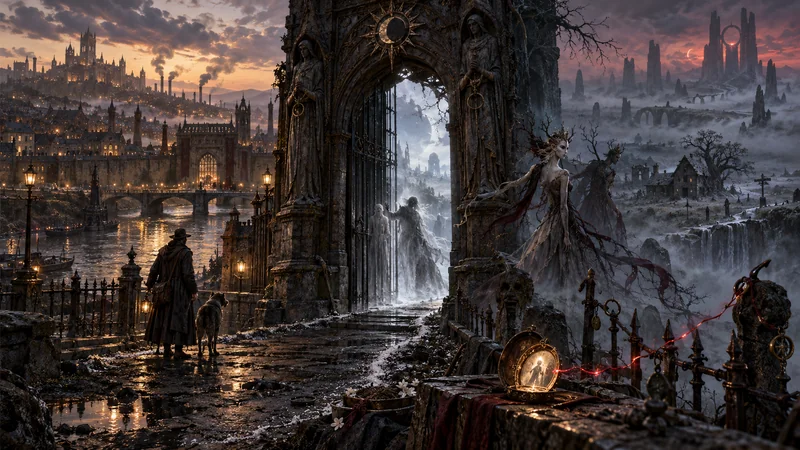
Gallowgate
A crumbling repertory theatre where the understudies are better than the cast and everyone knows it.
di Smagik
Ambientazione e lore
Gallowgate is a dark fantasy world governed by the Law of Thresholds: boundaries are metaphysically real. Doors, bridges, borders, graves, shorelines, names, vows, birth, death, sleep, exile, dusk, and dawn are all transitions, and transitions are where supernatural forces can act.
Magic is called Crossing. It cannot create something from nothing. Every working requires a threshold, a passage, and a toll. A threshold is where change occurs; a passage is what is moved or transformed; a toll is what must be surrendered.
Heat can be moved. Wounds can be transferred. Distance can be shortened. Memories can be stored outside the mind. Death can sometimes be delayed. The greater the change, the greater the toll. Small workings may cost blood, warmth, sleep, or memory. Greater workings may cost years of life, identity, fertility, relationships, or a true name. Magic that appears free is drawing its price from somewhere else.
Every person has a true name: the metaphysical boundary that defines them as themselves. A true name can be used to bypass protections or bind magic directly to a person. It changes only when identity itself changes.
Death is a crossing called the Long Door. For nine nights after bodily death, the dead remain near enough to the living world to dream, linger, or answer certain rites. After the ninth night, they pass beyond known reality.
A ghost is someone prevented from completing that passage. The longer a ghost remains, the less human it becomes.
Resurrection is possible only while some part of the dead person's passage remains unfinished, and an equivalent toll must cross the other way. Failed resurrection creates the Returned: people who come back missing some permanent part of themselves.
The physical world overlaps with the Hinter, a realm formed from things reality has abandoned without fully erasing: forgotten roads, ruined homes, dead borders, lost names, unmarked graves, and vanished settlements. Geography in the Hinter follows meaning rather than distance.
The Fair come from the Hinter. They are not elves or humans. Their identities are unstable and are shaped by names, titles, bargains, reputation, and repeated stories. A being called a king for long enough may become kinglike. A creature repeatedly described as monstrous may eventually become a monster. Folklore can therefore alter supernatural reality.
Promises made across meaningful thresholds can become Covenants. Breaking one damages the oath-breaker's identity. Enough damage produces a Hollow: a living person whose weakened boundaries allow foreign memories, spirits, emotions, or beings to enter.
Most monsters are not natural species. They are consequences of broken crossings. A corpse denied death may become a revenant. An animal given human memories may gain human thought. A person transformed too many times may lose a stable body. A place saturated with unresolved death may become aware.
Iron reinforces identity and resists transformation. Salt creates separation and can form artificial thresholds. Running water constantly renews its own boundary and is difficult for many supernatural beings to cross. None of these protections are absolute.
Religion remains uncertain. Miracles occur, but no god has conclusively revealed itself. Their source may be divine, magical, collective, or connected to something beyond the Long Door.
Civilization is built around controlling thresholds. Cities regulate gates. States regulate borders. Temples regulate funerals. Courts regulate vows. Guilds regulate magic. Families regulate names and inheritance. These customs have supernatural consequences as well as legal ones.
Technology is roughly early industrial: firearms, printing, factories, steam power, railways, and primitive electrical science exist. Magic has not replaced technology because every supernatural effect demands payment. Coal is usually cheaper than memory.
Six centuries ago, an unknown civilization attempted to create a permanent passage through death. The event, called the Opening, failed and weakened boundaries across the world. The Hinter became accessible, ghosts multiplied, and Crossing became easier.
The civilization responsible vanished. Its surviving structures are called Dead Gates, and every known Dead Gate is sealed.
The fundamental law of Gallowgate is simple:
Nothing crosses without leaving something behind.
The price can be hidden, delayed, transferred, or misunderstood, but it is always paid.
Informazioni sul mondo
- The covenant
- 1911 lease clause: a full season a year, or the freehold reverts.
- The house
- Seats 412. Sells about 90.
- Pay
- Equity minimum, late.
- The boiler
- Installed 1974, named Geoffrey.
Contesto della storia
Personaggi
Personaggi di The Understudy
Caricamento dei personaggi pubblici di questa storia…